Ceramics Preparation
A comprehensive guide to preparing ceramic samples for metallographic analysis, covering sectioning hard materials, preventing chipping and cracking, and revealing grain boundaries without pullout.
Introduction
Ceramics are among the most challenging materials to prepare for metallographic analysis. Their extreme hardness, brittleness, and tendency to chip or crack require specialized techniques throughout the entire preparation process. Unlike metals, ceramics often require diamond tools at every stage, very slow cutting speeds, and extended grinding and polishing times.
Key Challenge: Ceramics are extremely hard and brittle. They require diamond blades for sectioning, very slow cutting speeds to prevent chipping, and extended grinding and polishing times. Special care must be taken to avoid cracking and pullout of hard phases.
Common ceramic materials include alumina (Al₂O₃, ~2000 HV), zirconia (ZrO₂, ~1200-1500 HV), silicon carbide (SiC, ~2500-3000 HV), silicon nitride (Si₃N₄, ~1500-1800 HV), boron carbide (B₄C, ~2800 HV), and various oxide ceramics. Each type has specific hardness and brittleness characteristics that influence preparation. For example, silicon carbide is among the hardest ceramics and requires the most aggressive diamond abrasives, while zirconia may be more susceptible to phase transformation under stress. The fundamental principles remain the same: minimize mechanical damage, prevent chipping, and reveal grain boundaries without pullout.
Ceramic Material Characteristics
- • Alumina (Al₂O₃): Very hard (~2000 HV), chemically stable, commonly used in wear applications
- • Zirconia (ZrO₂): High toughness for a ceramic, may undergo phase transformation, requires careful handling
- • Silicon Carbide (SiC): Extremely hard (~2500-3000 HV), requires aggressive diamond abrasives throughout
- • Silicon Nitride (Si₃N₄): High strength and hardness, good thermal shock resistance
- • Boron Carbide (B₄C): One of the hardest known materials (~2800 HV), extremely challenging to prepare
- • Porous Ceramics: May require vacuum impregnation during mounting to prevent pullout
- • Glass & Glass-Ceramics: Softer than oxide/nitride/carbide ceramics — can be ground with SiC papers (400 → 600 grit; ≈ FEPA P800 → P1200) rather than requiring diamond throughout. The canonical optical polish is cerium oxide (CeO₂) on a hard pad, finished with colloidal silica. Glass-ceramics (Pyroceram, mica-glass, alumino-silicate) need diamond for the ceramic phase plus CeO₂ to handle the glass phase.
- • Cermets (WC-Co, WC-Ni): Hard particle / soft binder system — opposite challenge to monolithic ceramic. The cobalt or nickel binder is much softer than WC, so relief at the carbide-binder interface is the dominant prep failure, not pullout. Diamond ladder throughout; keep polishing times short to limit binder relief; etch with Murakami's reagent for the WC carbide structure or 2% Nital for the binder phase (often both, sequentially).
- • Ceramic Matrix Composites (CMC): Fiber-reinforced ceramics (SiC/SiC, C/SiC, oxide/oxide). Vacuum impregnation is mandatory, often multi-cycle — fiber loss at the matrix-fiber interface is the primary failure mode, and inadequate impregnation guarantees it. Diamond ladder, light force throughout, typically examined unetched with phase identification by SEM/EDS.
This guide will walk you through the complete preparation process, with special emphasis on the unique challenges ceramics present and how to overcome them.
Sectioning
Sectioning ceramics is one of the most critical steps. The extreme hardness of ceramics requires diamond blades, and their brittleness demands very slow cutting speeds to prevent chipping and cracking. Standard abrasive blades will not work for most ceramics.
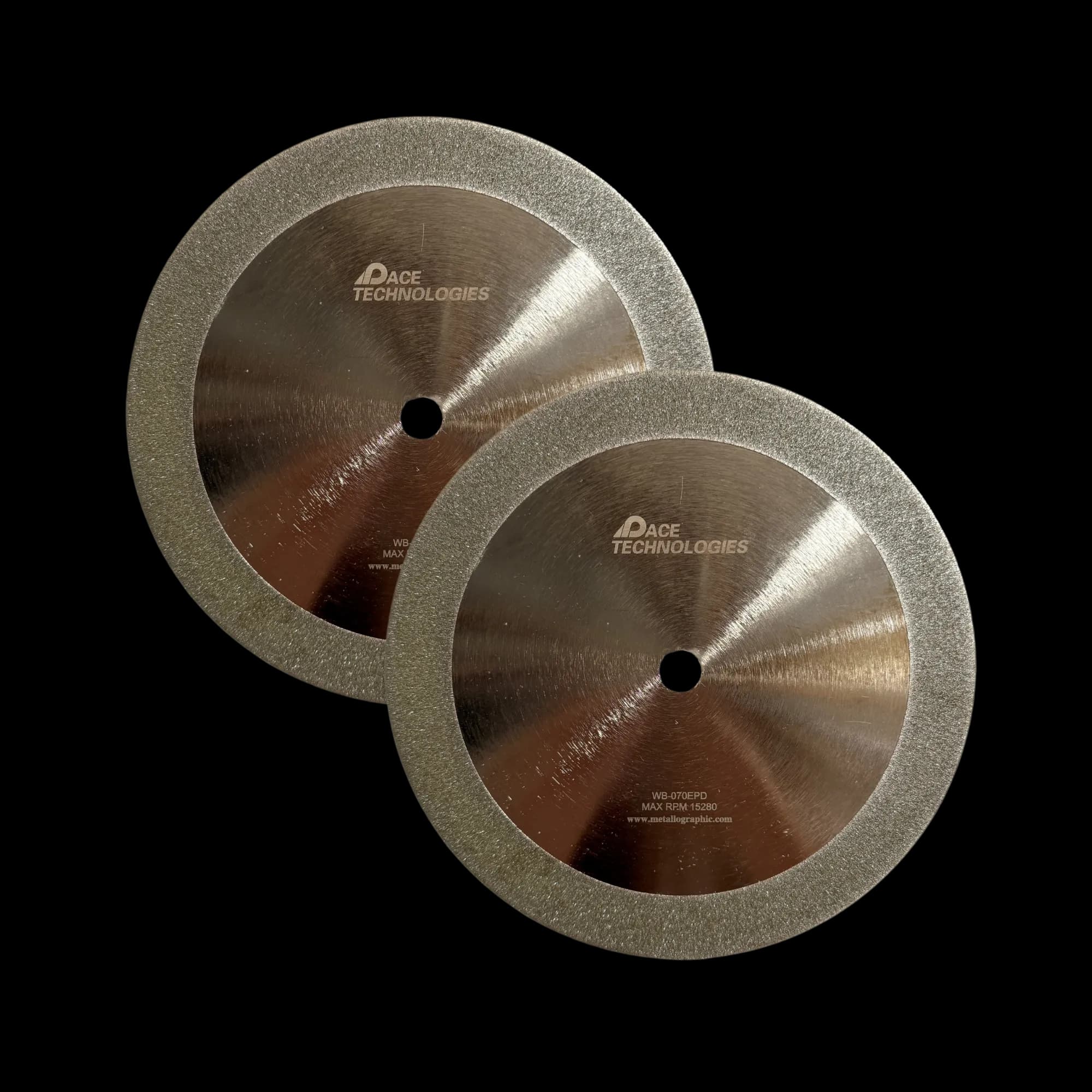
Diamond cut-off blades are essential for sectioning ceramics. Standard abrasive blades will not cut through hard ceramic materials effectively.
Cutting Parameters
- Blade Type: Diamond-impregnated cut-off wheels (required - standard abrasive blades will not work). Use resin-bonded diamond for general ceramic work (alumina, glass-ceramics); metal-bonded or electroplated diamond for the hardest, toughest grades (SiC, B₄C, Si₃N₄, ZrO₂)
- Speed and Load (precision wafering saw): Alumina ceramics: 1,500 RPM or higher with about 500 g applied load on a medium-grit blade. Tougher, harder grades (Si₃N₄, ZrO₂): 3,500 RPM or higher with about 800 g load. Blade speed itself rarely causes chipping — feed rate and lateral support do
- Feed Rate: On gravity- or load-fed precision saws, feed is set by the applied load above. On table-feed machines, use a slow steady feed and reduce it further for thin, fragile, or thermal-shock-sensitive samples (Si₃N₄, ZrO₂)
- Cooling: Continuous, copious coolant flow is essential to prevent thermal shock. Use water-based cutting fluid, not oil-based for ceramics
- Blade Thickness: Thin blades (0.3-0.5 mm) minimize kerf loss but require more care. Thicker blades (0.5-0.8 mm) provide more stability for very brittle ceramics
- Blade Condition: Use sharp, fresh diamond blades. Worn blades generate excessive heat and cause chipping
Best Practices
- Match the blade to the ceramic: resin-bonded diamond for general work, metal-bonded or electroplated for the hardest grades
- Do not rush the feed - excess feed and poor lateral support cause chipping, far more than wheel speed does. For SiC and B₄C, use the lowest practical feed and load
- Apply minimal pressure - let the diamond do the cutting. Excessive force causes chipping and blade wear
- Ensure continuous, copious coolant flow throughout the cut to prevent thermal shock cracking
- Support the sample properly to prevent vibration and chipping. Use appropriate fixtures for small or irregular samples
- For very brittle ceramics or thin sections, use a precision wafering saw with a thin diamond blade at low load - precision wafering leaves a damage layer roughly 10× thinner than abrasive cutoff
- Cut in multiple shallow passes (0.5-1.0 mm per pass) rather than forcing through in one deep cut
- For anisotropic ceramics (e.g., some SiC), consider cutting direction relative to grain orientation
- Inspect sample immediately after cutting for chips or cracks before proceeding to mounting
Important: Chipping during sectioning is often irreparable. Take your time and use the lowest practical feed rate and load. It's better to spend extra time sectioning than to have to start over with a new sample.
Example Products: Diamond Cut-Off BladesDiamond-impregnated cut-off wheels specifically designed for hard, brittle materials like ceramics
For purchasing options and product specifications, see commercial supplier website.
Mounting
Mounting ceramics requires special considerations. The mounting material must provide good edge retention and support to prevent chipping during grinding and polishing. For most ceramic work, castable (cold) mounting with low-viscosity epoxy is the first choice — it avoids the thermal cycle and pressure of compression mounting, which can crack thin sections and propagate existing micro-cracks. Compression mounting with epoxy resins is a good option for dense, robust ceramics (bulk alumina, sintered SiC) where edge retention is the priority.
Mounting Materials
- Epoxy Resins: Preferred among compression resins for ceramics - good edge retention, low shrinkage, and better chemical resistance. Mineral- or glass-filled epoxies give the best edge retention because the hard filler polishes at a rate close to the ceramic
- Phenolic Resins: Acceptable for routine work on robust ceramics but does not provide as good edge retention as epoxy - it is more brittle and shrinks more on cooling (same 150-180°C compression cycle)
- Cold Mounting: Essential for very fragile ceramics or those with existing cracks - completely avoids thermal stress. Use low-viscosity epoxies for better infiltration
- Vacuum Impregnation: Required for porous ceramics to ensure complete infiltration and prevent pullout during grinding/polishing. Mandatory for ceramic matrix composites (CMCs) — fiber loss at the matrix-fiber interface is the primary CMC failure mode, and a single vacuum cycle is usually not enough; multi-cycle impregnation (vacuum, vent, vacuum again) is standard practice to fully infiltrate fiber tows.
- Mounting Pressure: 2000-3000 psi for epoxy, 3000-4000 psi for phenolic. Lower pressure for fragile ceramics
- Mounting Temperature: 150-180°C for compression mounting. Lower temperatures (150-160°C) preferred for ceramics to minimize thermal stress
Mounting Procedure
Compression Mounting
- Clean the sample thoroughly with alcohol or acetone to remove cutting fluid and debris
- Inspect for any chips or cracks introduced during sectioning - if severe, consider starting with a new sample
- Select appropriate mold size (typically 1.25" or 1.5" diameter) - larger mounts provide better edge retention
- Place sample in mold with the surface of interest facing up
- Add mounting compound (epoxy preferred for ceramics)
- Mount at 150-160°C (lower than typical 180°C) and 2000-3000 psi for epoxy
- Hold at temperature for 5-8 minutes
- Cool slowly to room temperature under pressure (allow 10-15 minutes cooling time) before removing from mold
Cold Mounting
- Clean and dry the sample thoroughly
- For porous ceramics: Place in vacuum chamber and evacuate to remove air from pores
- Place sample in mounting cup with low-viscosity epoxy resin
- If using vacuum impregnation: Apply vacuum again to draw resin into pores
- Allow to cure at room temperature (4-8 hours, or overnight for best results)
- Cold mounting completely eliminates thermal stress risk
Special Consideration: For very fragile ceramics or those with existing cracks, cold mounting is essential to avoid thermal stress that could cause further damage. Porous ceramics (e.g., some thermal barrier coatings, filters) require vacuum impregnation to prevent pullout during grinding and polishing. The slower curing time is worth the reduced risk of cracking and better edge retention.
Grinding
Grinding ceramics requires diamond grinding wheels or diamond-impregnated papers. Standard SiC papers will not effectively grind most ceramics. The process is slow and requires extended times at each grit to remove previous scratches completely.
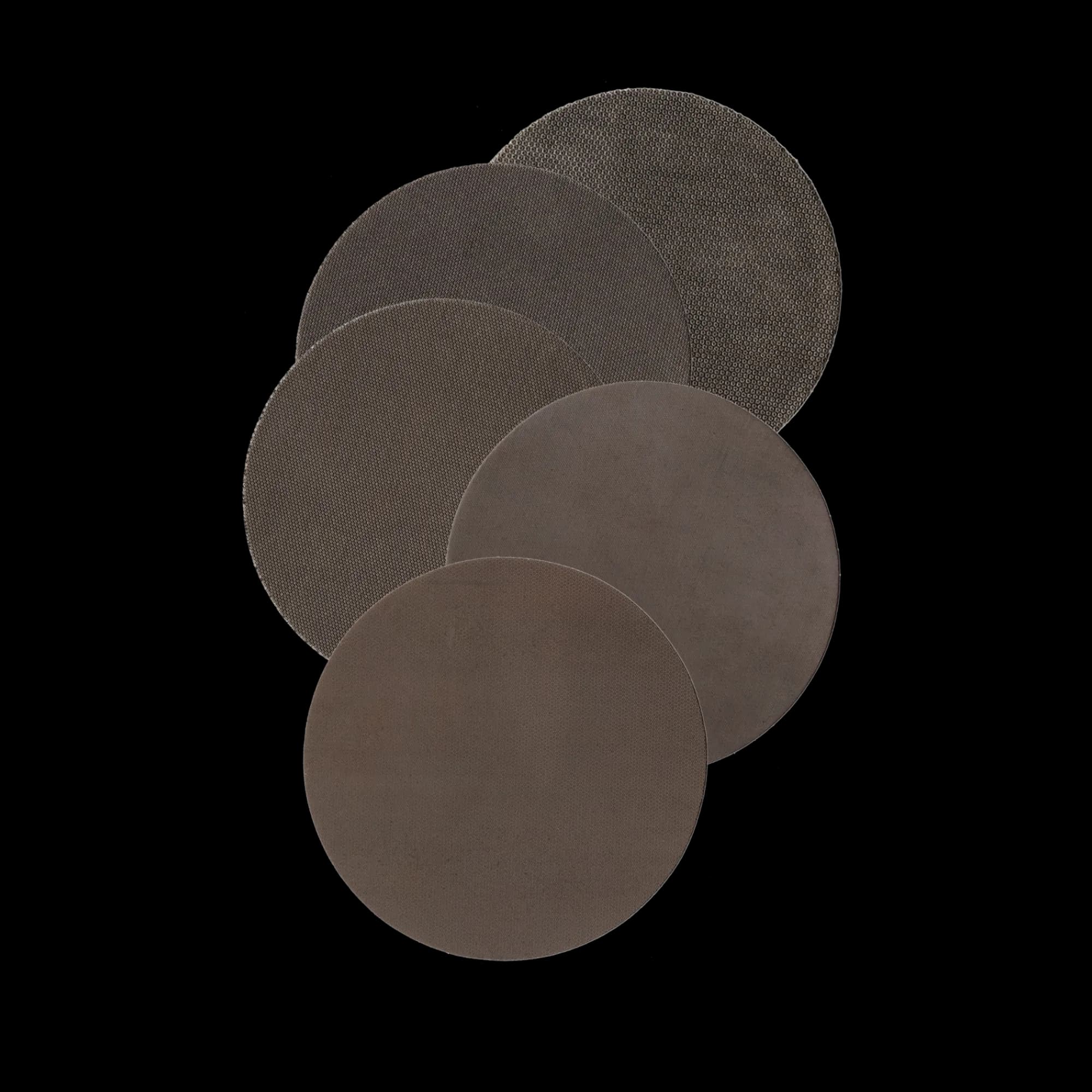
Diamond grinding wheels or diamond-impregnated papers are required for ceramics. Standard SiC papers will not effectively grind hard ceramic materials.
Grinding Sequence
Use diamond-impregnated grinding wheels or diamond-impregnated papers. Metal-bonded diamond wheels are preferred for hardest ceramics (SiC, B₄C), while resin-bonded wheels work well for others. Standard SiC papers will not effectively grind ceramics.
- Diamond 45-75 μm: Plane grind to remove sectioning damage - 1-3 minutes until plane
- Diamond 30 μm: Remove previous scratches - 3-5 minutes
- Diamond 15 μm: Further refinement - 3-5 minutes
- Diamond 9 μm: Fine grinding - 3-5 minutes
- Diamond 6 μm: Optional final grinding step - 3-5 minutes (recommended for hardest ceramics)
Note: For silicon carbide and boron carbide, extend each step by 50-100%. These materials are among the hardest known, and the fine-grind steps do the bulk of the damage removal — inspect at 200× between steps rather than running on the clock alone.
Grinding Parameters
- Abrasive: Diamond-impregnated wheels or papers (required). Metal-bonded diamond for hardest ceramics, resin-bonded for others
- Pressure: 30-40 N (about 7-9 lbs) per sample on rigid diamond discs - counter-intuitively, dense ceramics often need more grinding force than metals to keep the abrasive cutting. Reserve light pressure for fragile, thin, or porous samples where chipping or pullout is the concern
- Rotation: Rotate sample 90° between each grit to ensure complete scratch removal. For anisotropic ceramics, maintain consistent orientation
- Water Flow: Continuous water flow to remove debris and prevent loading. A loaded or glazed diamond disc is the most common cause of scratched ceramics
- Speed: 200-300 RPM for plane grinding; 150 RPM for fine grinding steps
- Time: Allow longer times than for metals (3-5 minutes per fine step; extend 50-100% for SiC/B₄C). Monitor progress frequently
- Wheel Condition: Use fresh diamond wheels/papers. Worn abrasives will take much longer and may cause damage
Grinding Tips for Ceramics
- • Use diamond grinding wheels or diamond-impregnated papers - standard SiC papers will not work
- • Metal-bonded diamond wheels provide more aggressive cutting for hardest ceramics (SiC, B₄C)
- • Allow extended time at each grit - ceramics require longer grinding times than metals, especially at the fine-grind steps
- • Ensure all scratches from previous grit are completely removed before proceeding - use magnification to verify
- • Use fresh diamond wheels/papers - worn abrasives will take much longer and may cause damage
- • Maintain consistent pressure throughout each step - avoid varying pressure which can cause relief
- • Check frequently for chipping or cracking - stop if damage is observed and assess if sample can be salvaged
- • For porous ceramics, ensure proper vacuum impregnation before grinding to prevent pullout
- • Consider sample orientation for anisotropic ceramics to maintain consistent grinding behavior
Example Products: Diamond Grinding WheelsDiamond-impregnated grinding wheels and papers for hard ceramic materials
For purchasing options and product specifications, see commercial supplier website.
Polishing
Polishing ceramics requires diamond polishing throughout all steps. The extreme hardness means extended polishing times are necessary. The goal is to achieve a scratch-free surface while avoiding pullout of hard phases or grain boundaries.
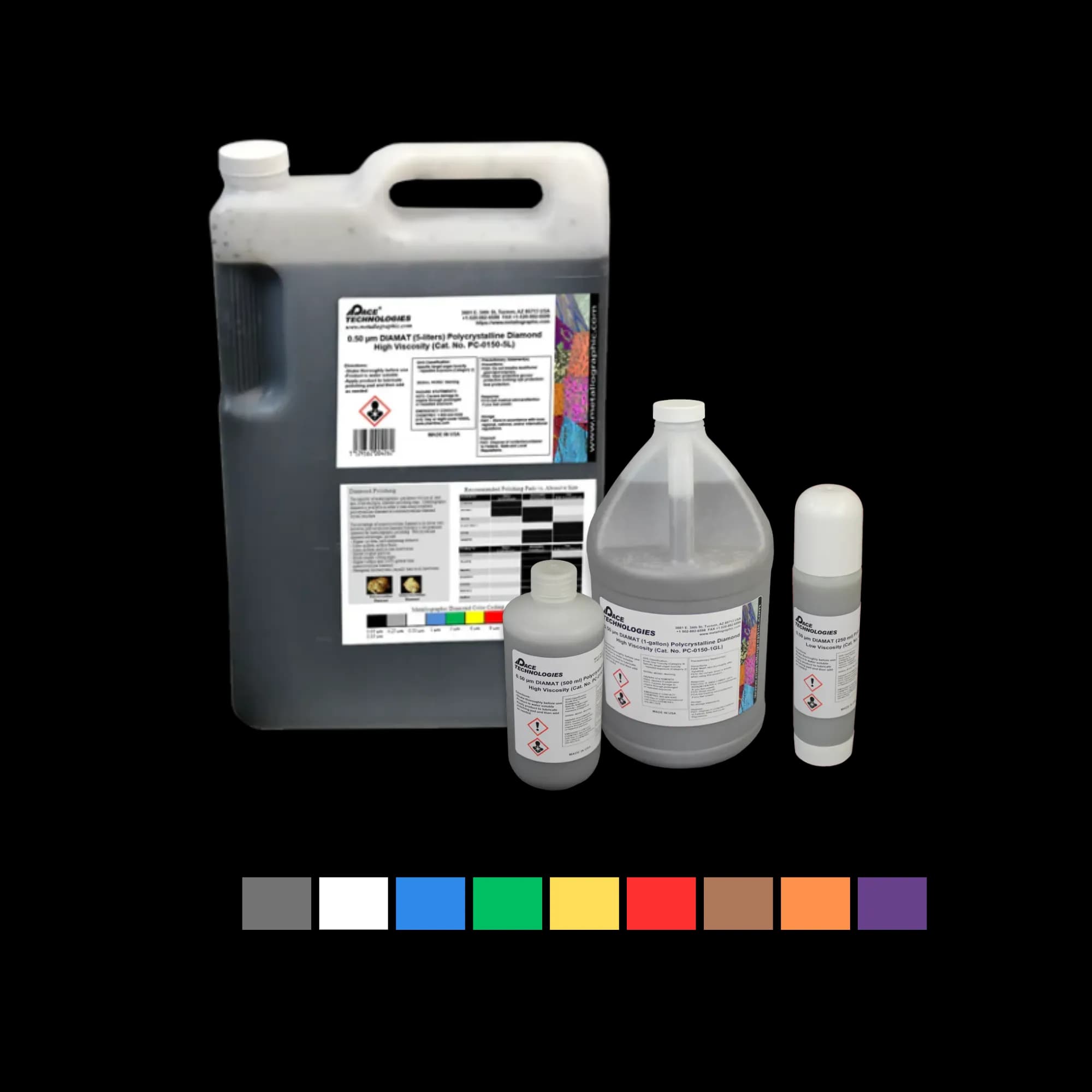
Polycrystalline diamond compound is essential for polishing ceramics. Extended polishing times are required at each step.
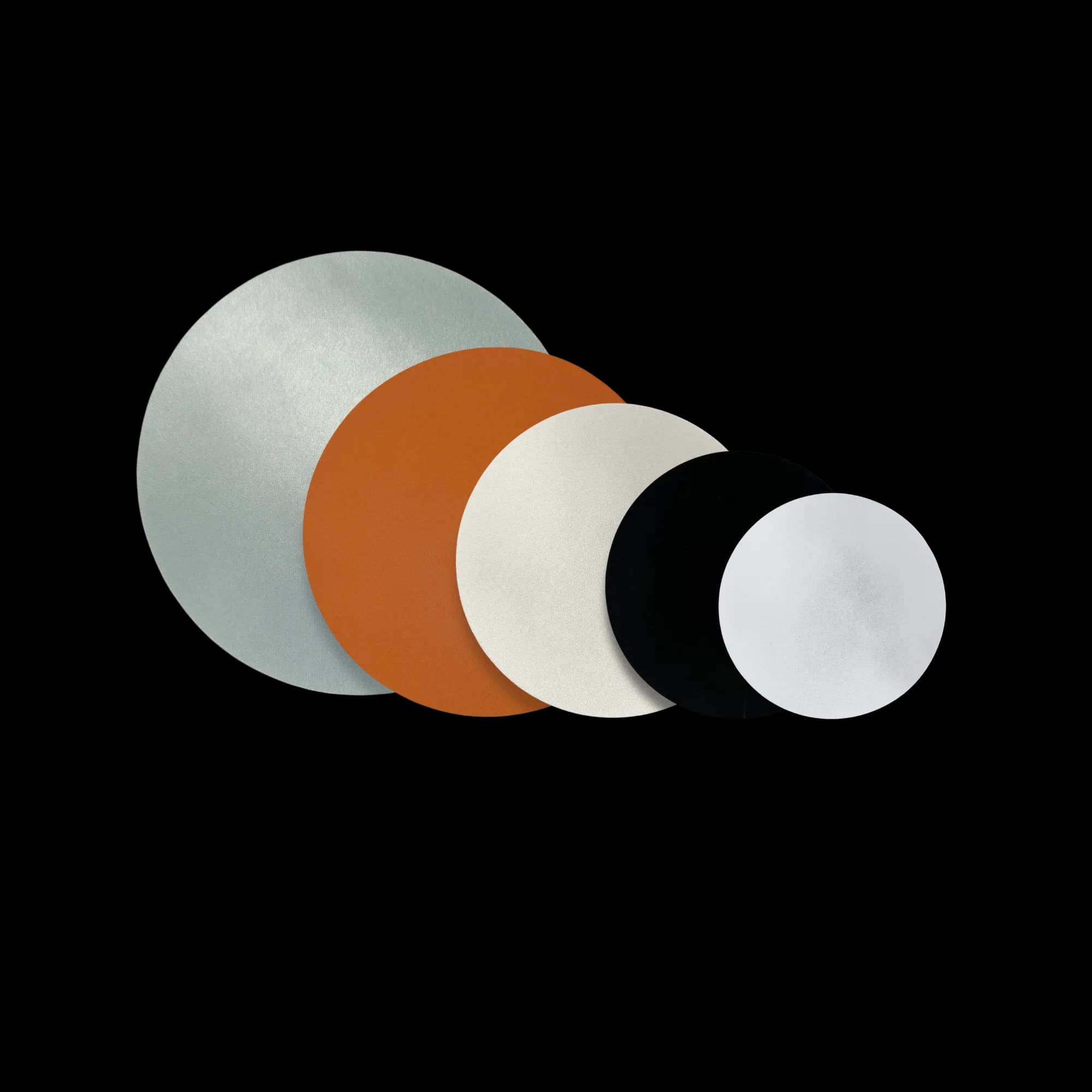
Medium to hard polishing pads are recommended for ceramics to maintain flatness and avoid pullout.
Diamond Polishing Sequence
Use polycrystalline diamond suspensions for ceramics - they provide more aggressive cutting than monocrystalline diamond. Water-based diamond suspensions are preferred, though oil-based can be used if water causes issues with certain ceramics.
- 9 μm diamond: About 5 minutes on a hard non-woven pad at 30 N (about 7 lbs) per sample. Use polycrystalline diamond for aggressive cutting
- 6 μm diamond: Optional intermediate step on a hard non-woven pad - insert for the hardest grades (SiC, B₄C)
- 3 μm diamond: 3-5 minutes on a low-nap pad at 25 N (about 5 lbs). Ensure all previous scratches are removed
- 1 μm diamond: 2-4 minutes on a low-nap pad at 20 N (about 4 lbs). Monitor for grain boundary pullout
- 0.25 μm diamond: Optional - 1-2 minutes on a soft napped cloth for samples headed to high-magnification SEM work
Note: These times are starting points for typical engineered ceramics (Al₂O₃, ZrO₂, dense Si₃N₄). For silicon carbide and boron carbide, extend each step by 50-100%. Inspect at 200× between steps; do not run on the clock alone.
Final Polishing
- 0.05 μm colloidal silica: 2-5 minutes on a high-nap (soft napped) pad or chemotextile. Use light pressure (10-15 N, about 2-3 lbs). Switch to plain water on the cloth for the last 30-60 seconds to flush silica off the sample - never let colloidal silica dry on a ceramic surface
- Rinse thoroughly with water and dry with compressed air. Avoid prolonged water exposure which could affect some ceramics
- For SEM or EBSD work, follow with a vibratory polish in colloidal silica for several hours to remove the residual work-damaged surface layer
- Inspect under microscope - grain boundaries may be visible without etching, especially with DIC (Differential Interference Contrast) microscopy
Alternative: For very hard ceramics where colloidal silica is insufficient, consider ion beam polishing as a final step. This technique uses ion bombardment to remove surface material without mechanical contact, eliminating the risk of pullout entirely.
Polishing Parameters
- Pressure: Step down with abrasive size: about 30 N (7 lbs) at 9 μm, 25 N at 3 μm, 20 N at 1 μm, 10-15 N (2-3 lbs) for the final colloidal silica step - avoid excessive pressure that could cause pullout
- Speed: 150 RPM throughout the polishing sequence
- Lubricant: Water-based diamond suspension preferred. Oil-based can be used but may require different cleaning procedures
- Diamond Type: Polycrystalline diamond provides more aggressive cutting for hard ceramics. Monocrystalline may be used for final steps
- Cloth Selection: Pad stiffness decreases as abrasive size decreases: hard non-woven pads for coarse steps, low-nap pads for intermediate steps, soft napped or chemotextile pads only for the final step
- Time: About 5 minutes at 9 μm tapering to 1-2 minutes at the final step; extend each step by 50-100% for the hardest ceramics
- Direction: Use consistent polishing direction. For anisotropic ceramics, maintain orientation relative to grain structure
Critical Consideration: The goal is to reveal grain boundaries without pullout. Use light pressure and extend polishing times. Over-polishing with too much pressure can cause grain boundary pullout, making it impossible to see the true microstructure. Monitor the surface frequently under magnification and adjust pressure and time as needed. For very hard ceramics where mechanical polishing is challenging, consider ion beam polishing as an alternative final step.
Special Case: Glass and Glass-Ceramics — Cerium Oxide (CeO₂)
For silicate glasses, soda-lime glass, borosilicate glass, and the glass phase in glass-ceramics, the canonical polish is cerium oxide (CeO₂) on a hard pad — not diamond. CeO₂ is the traditional optical-finish abrasive of the optics industry because it has chemo-mechanical action specific to silicate networks: it reacts with silica during polishing in a way diamond cannot, producing the optical-grade finish that glass requires. Diamond cuts glass mechanically but leaves subsurface damage CeO₂ removes. Standard glass workflow:
- Grind: SiC 320 → 400 → 600 grit (≈ FEPA P400 → P800 → P1200), optionally finishing at 1200 grit (≈ P2500) — glass is softer than oxide ceramics; SiC works fine here, no need for the diamond ladder
- Polish: Cerium oxide (CeO₂) slurry on a hard pad, light pressure, 5-15 minutes
- Final: Colloidal silica on a soft pad, 2-5 minutes + flush
- Etch: Usually unetched; dilute HF for revealing devitrification only when needed
For glass-ceramics (Pyroceram, mica-glass, alumino-silicate), use the diamond ladder for the ceramic phase, then finish with CeO₂ on a hard padbefore colloidal silica — the CeO₂ step handles the glass phase that the diamond ladder leaves under-finished.
Alternative Polishing Methods
For extremely hard ceramics or when grain boundary pullout is a persistent problem, consider these alternatives:
- Ion Beam Polishing: Uses ion bombardment to remove material without mechanical contact. Eliminates pullout risk entirely but requires specialized equipment. Best for final polishing of hardest ceramics.
- Vibratory Polishing: Can be used for final polishing with very light pressure. Less aggressive than mechanical polishing, reducing pullout risk.
- Electrochemical Polishing: Limited applicability to ceramics, but may work for some conductive ceramics or ceramic composites.
Example Products: Polishing Padsappropriate polishing pads for different polishing stages on hard ceramic materials
For purchasing options and product specifications, see commercial supplier website.
Etching
Etching ceramics is often more challenging than etching metals. Many ceramics are chemically inert and do not respond well to traditional chemical etchants. Thermal etching is commonly used for ceramics, and some ceramics may not require etching at all if the grain boundaries are visible after polishing.
Important Note: Not all ceramics can be etched effectively. Some ceramics may reveal grain boundaries through careful polishing alone. Thermal etching is often the preferred method for ceramics that require etching.
Thermal Etching
Thermal etching is the most common method for revealing grain boundaries in ceramics. The sample is heated to a temperature below the sintering temperature (typically 100-200°C below) for a specific time, which causes grain boundaries to become visible through surface diffusion.
Thermal Etching Procedure
- Ensure sample is clean and dry after final polishing - any contamination will affect results
- Place sample in a furnace preheated to the appropriate temperature (typically 100-200°C below sintering temperature)
- Use appropriate atmosphere (air, vacuum, or controlled atmosphere depending on ceramic)
- Heat for 30 minutes to 2 hours (time and temperature depend on ceramic type and grain size)
- Cool slowly to room temperature (furnace cool or controlled cooling rate) to avoid thermal shock
- Inspect under microscope - grain boundaries should be visible. Adjust time/temperature if needed
Important: Thermal etching can alter the microstructure if temperature is too high or time is excessive. Always stay well below the sintering temperature. For fine-grained ceramics, shorter times and lower temperatures are typically sufficient.
Typical Thermal Etching Conditions
- Alumina (Al₂O₃): 1400-1500°C for 30-60 minutes in air. Fine-grained alumina may require shorter times (20-30 minutes)
- Zirconia (ZrO₂): 1200-1300°C for 30-60 minutes in air. Be careful with temperature to avoid phase transformation
- Silicon Carbide (SiC): 1800-1900°C for 30-60 minutes in inert atmosphere (Ar or N₂). Air will cause oxidation
- Silicon Nitride (Si₃N₄): 1400-1500°C for 30-60 minutes in N₂ (or vacuum/Ar) atmosphere. Air will oxidize the surface to SiO₂
- Boron Carbide (B₄C): 1800-2000°C for 30-60 minutes in inert atmosphere. Very high temperature required
Atmosphere Considerations: Some ceramics require specific atmospheres for thermal etching. Silicon carbide and silicon nitride will oxidize in air at thermal-etching temperatures. Always use the appropriate atmosphere for the ceramic type. Consult material-specific literature for exact conditions.
Safety Warning: Thermal etching requires high-temperature furnaces. Always follow proper safety procedures, use appropriate personal protective equipment, and ensure proper ventilation. Be aware that thermal etching can alter the microstructure if temperature or time is excessive.
Chemical Etching
Chemical etching is less common for ceramics but may work for some oxide ceramics. The effectiveness varies greatly depending on the ceramic composition.
Common Chemical Etchants for Ceramics
- Phosphoric Acid (H₃PO₄): Hot concentrated phosphoric acid (85 mL H₃PO₄ + 15 mL H₂O, boiling, 5 minutes to 2 hours) reveals grain boundaries in alumina; high-purity alumina needs the longer times. Not effective on SiC — carbides require molten-salt chemistry.
- Molten KOH / NaOH: The canonical chemical etch for SiC and Si₃N₄ grain boundaries. Specialty equipment (corrosion-resistant crucible, controlled heating); typically reserved for cases where thermal etching is impractical and grain-boundary contrast is required.
- Hydrofluoric Acid (HF): Dilute HF for silicon-based ceramics and for revealing devitrification in glasses. Fume hood, HF-rated PPE, calcium gluconate gel on hand.
Safety Warning: Chemical etching of ceramics often requires strong acids including hydrofluoric acid, which is extremely dangerous. Always use appropriate personal protective equipment, work in a fume hood, and follow all safety protocols. Many ceramics cannot be chemically etched effectively, so thermal etching is preferred.
Special Case: Cermets (WC-Co, WC-Ni)
Cermets need a dual-etch workflow because the two phases respond to different chemistry:
- Murakami's reagent (10 g K₃[Fe(CN)₆] + 10 g NaOH + 100 mL H₂O): Reveals the WC carbide structure — grain shape, size, and contiguity. Swab 5-30 s.
- 2% Nital (2 mL HNO₃ in 98 mL ethanol): Reveals the cobalt or nickel binder phase between WC grains. Swab 5-15 s.
Apply Murakami's first to image the carbide skeleton, then Nital on top to bring out the binder. The dominant cermet prep concern is relief at the WC-binder interface — the binder is much softer than WC and recedes faster during polishing — so keep polishing times short and don't extend etch times to compensate.
No Etching Required
Some ceramics, particularly those with good contrast between grains (e.g., different phases, porosity, or orientation contrast) or those that have been carefully polished, may reveal grain boundaries without any etching. Always examine the polished surface first using:
- Brightfield microscopy: Check for natural contrast between grains
- DIC (Differential Interference Contrast): Often reveals grain boundaries without etching
- Polarized light: Useful for anisotropic ceramics (e.g., some SiC, alumina)
- Darkfield microscopy: Can enhance contrast for some ceramic microstructures
If grain boundaries are visible with these techniques, etching may not be necessary. This is particularly true for ceramics with multiple phases or porosity that provides natural contrast.
Etching Procedure (Chemical)
- Ensure sample is clean and dry
- Apply etchant using cotton swab or immerse sample (depending on etchant)
- Etch for appropriate time (varies greatly by ceramic and etchant)
- Rinse immediately with water, then alcohol
- Dry with compressed air
Tip: For ceramics, thermal etching is generally preferred over chemical etching. If chemical etching is necessary, start with very short times and increase gradually. Many ceramics will not respond to chemical etching at all.
Troubleshooting
Common Issues and Solutions
Problem: Chipping During Sectioning
Symptoms: Chips or cracks visible at edges after sectioning
Solutions: Reduce the feed rate and applied load, use diamond blades, ensure proper sample support so the cut exits into supported material, use copious coolant, consider multiple shallow passes instead of one deep cut
Problem: Cracking During Mounting
Symptoms: Cracks visible in sample after mounting
Solutions: Use cold mounting instead of compression mounting, reduce mounting temperature, allow slower cooling, ensure sample is not stressed before mounting
Problem: Scratches Not Removing
Symptoms: Scratches from previous grit still visible after grinding/polishing
Solutions: Extend grinding/polishing time at each step (ceramics require much longer times), ensure using diamond abrasives (not SiC), use fresh abrasives, check that all scratches are removed before proceeding to next grit, rotate sample 90° between grits
Problem: Grain Boundary Pullout
Symptoms: Holes or pits at grain boundaries, missing grains
Solutions: Reduce polishing pressure, keep the diamond steps on firm low-nap pads (moving to napped cloths too early increases pullout), avoid over-polishing, use colloidal silica for the final polish, and verify vacuum impregnation on porous grades
Problem: No Grain Boundaries Visible
Symptoms: Flat, featureless surface after polishing, no contrast
Solutions: Try thermal etching (most common for ceramics), check if grain boundaries are visible with different lighting (DIC, polarized light), some ceramics may not show grain boundaries easily, ensure proper polishing to avoid artifacts that obscure structure
Problem: Excessive Preparation Time
Symptoms: Preparation taking much longer than expected
Solutions: This is normal for ceramics - they require extended times at each step (especially SiC and B₄C). Ensure using diamond abrasives throughout (not SiC), use fresh abrasives, use polycrystalline diamond for more aggressive cutting, maintain consistent pressure, but accept that ceramics simply take longer than metals. For hardest ceramics, consider ion beam polishing as an alternative for final steps.
Problem: Porous Ceramic Pullout
Symptoms: Material pulling out from pores, holes in microstructure
Solutions: Use vacuum impregnation during mounting to fill pores completely, use low-viscosity epoxy resin, ensure proper vacuum level and time, use lighter polishing pressure, consider using mounting material with similar hardness to ceramic to prevent relief
Problem: Phase Transformation (Zirconia)
Symptoms: Cracking or microstructural changes in zirconia samples
Solutions: Use lower cutting speeds during sectioning, avoid excessive pressure during grinding/polishing, use cold mounting instead of compression mounting, avoid thermal etching at temperatures that cause phase transformation, use gentle preparation techniques throughout
Problem: Thermal Etching Not Working
Symptoms: No grain boundaries visible after thermal etching
Solutions: Increase temperature (but stay below sintering temperature), extend etching time, ensure proper surface finish before thermal etching, some ceramics may require very specific conditions - consult literature for your specific ceramic type
Explore More Procedures
Browse our comprehensive procedure guides for material-specific preparation methods and get personalized recommendations.