Etching Procedures
Overview of etching techniques, reagent selection, and application methods. Learn how to reveal microstructures effectively and safely for metallographic analysis.
Table of Contents
Introduction
Etching is a critical step in metallographic sample preparation that reveals the microstructure of a material by selectively attacking different phases, grain boundaries, and structural features. After polishing, the sample surface is featureless and appears uniform under the microscope. Etching creates contrast between different microstructural constituents, making them visible for analysis.
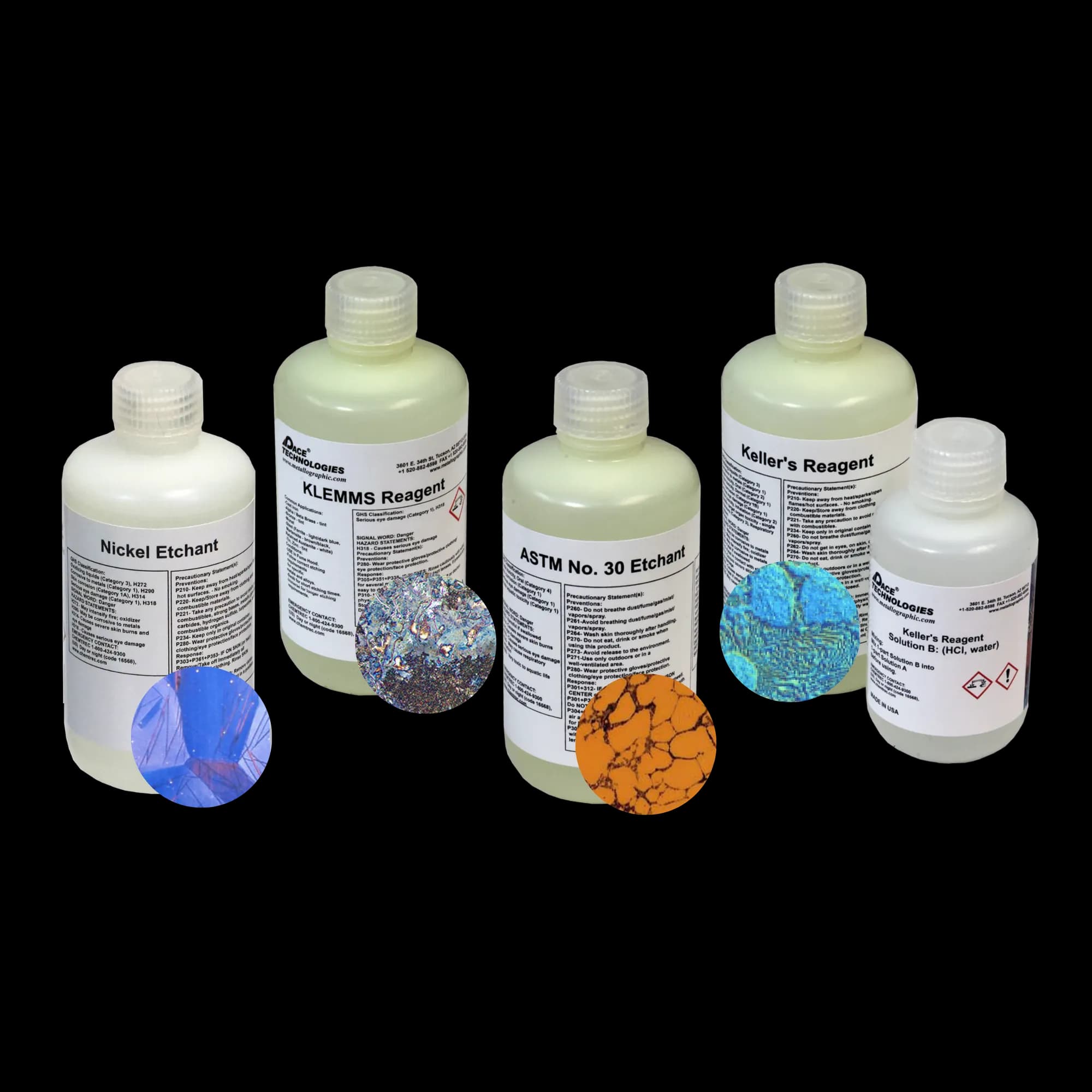
Etching reagents and consumables for metallographic analysis. Proper etchant selection and application reveal microstructures for accurate characterization.
The etching process involves applying a chemical reagent (etchant) to the polished surface, which reacts differently with various phases and structural features. This differential attack creates height differences (relief) or changes in reflectivity, producing contrast that reveals the microstructure.
Guide Structure: This guide covers the fundamentals of etching, from understanding why we etch to selecting appropriate etchants, learning application methods, and troubleshooting common issues. Always prioritize safety when working with chemical etchants.
Purpose of Etching
Etching serves several essential purposes in metallographic analysis:
- Reveal Microstructure: Makes grain boundaries, phase boundaries, and different microstructural constituents visible under the microscope.
- Create Contrast: Produces differences in reflectivity or height that allow identification of different phases and features.
- Highlight Defects: Makes cracks, inclusions, and other defects more visible for analysis.
- Identify Phases: Different phases react differently to etchants, allowing phase identification and characterization.
- Measure Grain Size: Reveals grain boundaries necessary for grain size measurements and ASTM grain size determination.
Without etching, most polished samples appear featureless because all microstructural constituents have similar reflectivity. Etching is what transforms a polished surface into an informative microstructural image.
Types of Etchants
Etchants can be classified based on their chemical composition and mechanism of action:
Chemical Etchants
Chemical etchants use chemical reactions to selectively attack different phases. They are the most common type and include:
- Acidic Etchants: Such as nital (nitric acid in ethanol), picral (picric acid in ethanol), and various acid mixtures. These attack grain boundaries and phase boundaries preferentially.
- Alkaline Etchants: Such as sodium hydroxide solutions, used for specific materials like aluminum and its alloys.
- Oxidizing Agents: Such as potassium permanganate, used for specific microstructural features.
Electrolytic Etchants
Electrolytic etching uses an electrical current to enhance or control the etching process. The sample acts as an electrode in an electrolytic cell:
- Anodic Etching: Sample is the anode (positive electrode), commonly used for stainless steels and other corrosion-resistant materials.
- Cathodic Etching: Sample is the cathode (negative electrode), less common but useful for specific applications.
Electrolytic etching provides better control over etching depth and can reveal microstructures that are difficult to etch chemically.
Thermal Etching
Thermal etching involves heating the sample in a controlled atmosphere to reveal grain boundaries through surface diffusion. This method is useful for materials that are difficult to etch chemically and for high-temperature applications.
Color Etchants
Color (tint) etchants deposit a thin oxide or sulfide film that grows at different rates on different phases, producing optical interference colors that allow easy visual distinction between phases. Examples include Klemm's I (stainless and copper alloys), Beraha's reagents (irons and steels), and Weck's reagent (aluminum and magnesium alloys). These are particularly useful for complex microstructures with multiple phases.
Surface requirement: Color etching only works on a deformation-free surface, which in practice means a colloidal-silica final polish. It will not work on a smeared or mechanically damaged surface.
Etchant Selection
Selecting the appropriate etchant depends on several factors:
Material Type
Different materials require different etchants. Common examples include:
- Steels: Nital (2–5% nitric acid in ethanol) is the most common general-purpose etchant. Picral (picric acid in ethanol — store wetted; dry picric is shock-sensitive) is preferred for cementite and fine pearlite contrast.
- Stainless steels — by class:
- Austenitic (304, 316): 10% oxalic acid electrolytic at 6 V, 30–90 s (per ASTM A262 Practice A) or Glyceregia (HNO₃ + HCl + glycerol; mix fresh — activity decays) by immersion.
- Martensitic (410, 420, 431): Vilella's reagent (1 g picric + 5 mL HCl + 95 mL ethanol).
- Ferritic (430, 446): Vilella's, or Marble's reagent for grain boundaries.
- Duplex (2205, 2507): Beraha's I or Klemm's I for color contrast between ferrite and austenite.
- Aluminum alloys: Keller's reagent (2 mL HF + 3 mL HCl + 5 mL HNO₃ + 190 mL H₂O) for general microstructure; Weck's tint etch for color phase contrast; Barker's anodizing under polarized light for grain orientation and ASTM E112 grain-size work.
- Copper alloys: Equal volumes 28% NH₄OH + 3% H₂O₂ (mixed fresh) is the standard for pure copper and brass. Alcoholic FeCl₃ is the etchant of choice for Mn-Al and Ni-Al bronzes specifically. Klemm's I gives vivid color contrast in bronzes.
- Titanium and Ti alloys: Kroll's reagent (2 mL HF + 6 mL HNO₃ + 92 mL H₂O — fume hood, HF-rated PPE) by swab 5–15 s. Weck's tint etch for color phase ID in α-β alloys.
Microstructural Features of Interest
The specific features you want to reveal influence etchant selection:
- Grain Boundaries: Most general-purpose etchants reveal grain boundaries.
- Specific Phases: Some etchants preferentially attack or highlight specific phases (e.g., picral for cementite in steel).
- Defects: Some etchants are better at revealing cracks, inclusions, or other defects.
Application Method
The available equipment and application method may influence etchant selection:
- Swabbing: Simple chemical etchants applied with cotton swabs.
- Immersion: Sample immersed in etchant solution.
- Electrolytic: Requires electrolytic etching equipment.
Tip: Browse our Etchant Reference to find the right etchant for your material and application — it also links to an extensive, searchable etchant database with free-tier access.
Example Products: EtchantsPre-mixed and custom etching solutions for various materials
For purchasing options and product specifications, see commercial supplier website.
Application Methods
There are several methods for applying etchants to polished samples:
Swabbing
Swabbing is the most common method for chemical etchants:
- Soak a cotton swab or ball in the etchant solution.
- Gently wipe the polished surface with the swab, applying light, even pressure.
- Continue swabbing for the recommended time (typically 5-30 seconds).
- Immediately rinse with water or appropriate solvent to stop the etching reaction.
- Dry the sample with compressed air or a clean cloth.
Advantages: Simple, requires minimal equipment, good control over etching time and area.
Disadvantages: Can introduce scratches if swab is too rough, requires practice for consistent results.
Immersion
Immersion involves submerging the sample in the etchant solution:
- Place the polished sample in a container with the etchant solution.
- Agitate gently or leave stationary for the recommended time.
- Remove and immediately rinse thoroughly.
- Dry the sample.
Advantages: Uniform etching, good for batch processing, less risk of scratches.
Disadvantages: Uses more etchant, less control over localized etching, requires proper disposal of used etchant.
Electrolytic Etching
Electrolytic etching requires specialized equipment:
- Set up the electrolytic cell with the sample as the anode (or cathode for cathodic etching).
- Immerse the sample in the electrolyte solution.
- Apply the appropriate voltage and current for the recommended time (for example, 10% oxalic acid at 6 V for 30-90 seconds for austenitic stainless steel).
- Remove power and rinse the sample thoroughly.
- Dry the sample.
Advantages: Excellent control, uniform results, can reveal difficult microstructures, reproducible.
Disadvantages: Requires specialized equipment, more complex setup, requires knowledge of electrical parameters.
Dropping
For small areas or spot etching, a drop of etchant can be applied directly:
- Place a drop of etchant on the area of interest.
- Allow it to react for the appropriate time.
- Rinse immediately and dry.
This method is useful for testing etchants or etching specific areas of a sample.
Etching Techniques
Proper technique is essential for achieving good etching results:
Etching Time
Etching time is critical and depends on:
- Etchant Concentration: More concentrated etchants work faster.
- Material: Different materials etch at different rates.
- Temperature: Higher temperatures generally increase etching rate.
- Desired Contrast: Longer etching may be needed for better contrast, but over-etching can obscure details.
Start with recommended times and adjust based on results. It's better to under-etch initially and re-etch if needed than to over-etch.
Rinsing
Proper rinsing immediately after etching is essential:
- Stop the Reaction: Rinsing stops the etching reaction and prevents over-etching.
- Remove Residue: Removes etchant residue that could cause staining or continued reaction.
- Use Appropriate Solvent: Water for water-based etchants, ethanol for alcohol-based etchants, or as recommended.
Drying
Proper drying prevents water spots and contamination:
- Use compressed air or a clean, lint-free cloth.
- Avoid touching the etched surface.
- Ensure complete drying before examination to avoid water spots.
Multiple Etching Steps
Some microstructures require multiple etching steps with different etchants:
- Step 1: Use a general etchant to reveal grain boundaries.
- Step 2: Use a specific etchant to highlight particular phases or features.
Always rinse thoroughly between steps to prevent etchant interactions.
Material-Specific Considerations
Different materials have specific etching requirements:
Steels
Carbon Steels: Nital (2-5 mL nitric acid in 95-98 mL ethanol) is standard. Picral reveals cementite and pearlite. Etching time: typically 5-30 seconds by swab.
Stainless Steels: Etchant choice depends on grade. Austenitic grades (304, 316) — 10% oxalic acid electrolytic at 6 V (30-90 s) or Glyceregia by immersion (mix fresh). Martensitic (410, 420, 431) and ferritic (430, 446) grades — Vilella's reagent (1 g picric + 5 mL HCl + 95 mL ethanol). Duplex grades (2205, 2507) — Beraha's I or Klemm's I for ferrite-vs-austenite color contrast. Stainless steels are generally more resistant to etching than carbon steels.
Tool Steels: May require multiple etchants or longer etching times due to high alloy content.
Aluminum Alloys
Keller's reagent (2 mL HF + 3 mL HCl + 5 mL HNO₃ + 190 mL H₂O) is most common. Weck's reagent provides color contrast. Typical etching time is 5-30 seconds by swab.
Note: Aluminum is very reactive, so etching times must be carefully controlled to avoid over-etching.
Copper Alloys
Equal volumes of 28% ammonium hydroxide and 3% hydrogen peroxide (mix immediately before use — the solution decomposes within hours), or ferric chloride solutions. Etching reveals grain boundaries and different phases in brass and bronze.
Titanium
Kroll's reagent (2 mL HF + 6 mL HNO₃ + 92 mL H₂O), applied by swab for 5-15 seconds, is standard — work in a fume hood with HF-rated PPE. Electrolytic etching (e.g., 10% oxalic acid at 5 V, 30-60 s) is an alternative for difficult alloys.
For detailed material-specific etching procedures, see our material-specific guides: Stainless Steel, Aluminum, Copper Alloys, Titanium, and Carbon Steel.
Safety Considerations
Etchants are chemical reagents that can be hazardous. Always prioritize safety. The four etchants below cover the highest-consequence hazards in routine metallography — read them before mixing or applying any reagent.
Personal Protective Equipment (PPE)
- Safety Glasses: Always wear safety glasses or goggles to protect eyes from splashes.
- Gloves: Wear appropriate chemical-resistant gloves (nitrile or neoprene for most etchants).
- Lab Coat: Protect clothing from spills and splashes.
- Face Shield: Use when working with concentrated acids or large volumes.
Ventilation
Work in a well-ventilated area or use a fume hood, especially when:
- Working with volatile etchants (alcohol-based solutions).
- Using concentrated acids.
- Working with HF (hydrofluoric acid) - requires special precautions and emergency procedures.
Chemical Handling
- Read SDS: Always read the Safety Data Sheet (SDS) before using any etchant.
- Proper Storage: Store etchants in appropriate containers, labeled clearly, in a secure location.
- Mixing: When preparing etchants, always add acid to water (never water to acid) to prevent violent reactions.
- Disposal: Follow proper disposal procedures for used etchants and contaminated materials.
Emergency Procedures
- Know the location of safety equipment (eyewash station, safety shower, first aid kit).
- Have emergency contact information readily available.
- For HF exposure, have calcium gluconate gel available and know the emergency procedure.
Important: Always refer to the Safety Fundamentals guide and the Safety Data Sheet Reference before working with etchants. When in doubt, consult with experienced personnel or safety officers.
Troubleshooting Common Etching Issues
Common problems and solutions when etching:
Over-Etching
Symptoms: Excessive relief, obscured details, dark appearance.
Solutions:
- Reduce etching time.
- Use a less concentrated etchant.
- Rinse immediately after etching.
- Re-polish and re-etch with shorter time.
Under-Etching
Symptoms: No contrast, grain boundaries not visible, featureless appearance.
Solutions:
- Increase etching time.
- Use a more concentrated etchant.
- Try a different etchant if the material is resistant.
- For stainless steels, consider electrolytic etching.
Uneven Etching
Symptoms: Some areas etched, others not; patchy appearance.
Solutions:
- Ensure even application (swabbing technique).
- Use immersion method for more uniform results.
- Check for contamination on the polished surface.
- Ensure sample is clean before etching.
Staining
Symptoms: Colored spots or stains on the surface.
Solutions:
- Rinse immediately and thoroughly after etching.
- Use appropriate rinsing solvent (water vs. alcohol).
- Dry completely to prevent water spots.
- Clean the sample surface before etching.
No Etching Effect
Symptoms: Etchant appears to have no effect.
Solutions:
- Verify etchant is appropriate for the material.
- Check etchant freshness (some etchants degrade over time).
- Try a different etchant.
- For resistant materials, use electrolytic etching.
- Ensure the polished surface is clean and free of contamination.
For more comprehensive troubleshooting guidance, see our Troubleshooting Quick Reference.
Find the Right Etchant for Your Material
Browse our etchant quick reference for common reagents, or shop pre-mixed etchants.
Etchant recipes drift as operators rotate and conditions change. Labs that need recipe consistency across operators sometimes use a metallography ELN like Materials Prep to keep the recipe book and the actual batch records in one place.