Copper and Copper Alloys Sample Preparation
A comprehensive guide to preparing copper and copper alloy samples (brass, bronze) for metallographic analysis, covering sectioning, mounting, grinding, polishing, and etching techniques.
Introduction
Copper and its alloys (brass, bronze) are commonly analyzed materials in metallography. Common examples include electrolytic tough pitch copper,cartridge brass, and various bronze alloys. Proper preparation is essential to reveal the true microstructure without introducing artifacts such as deformation, scratches, smearing, or contamination. This guide will walk you through the complete preparation process.
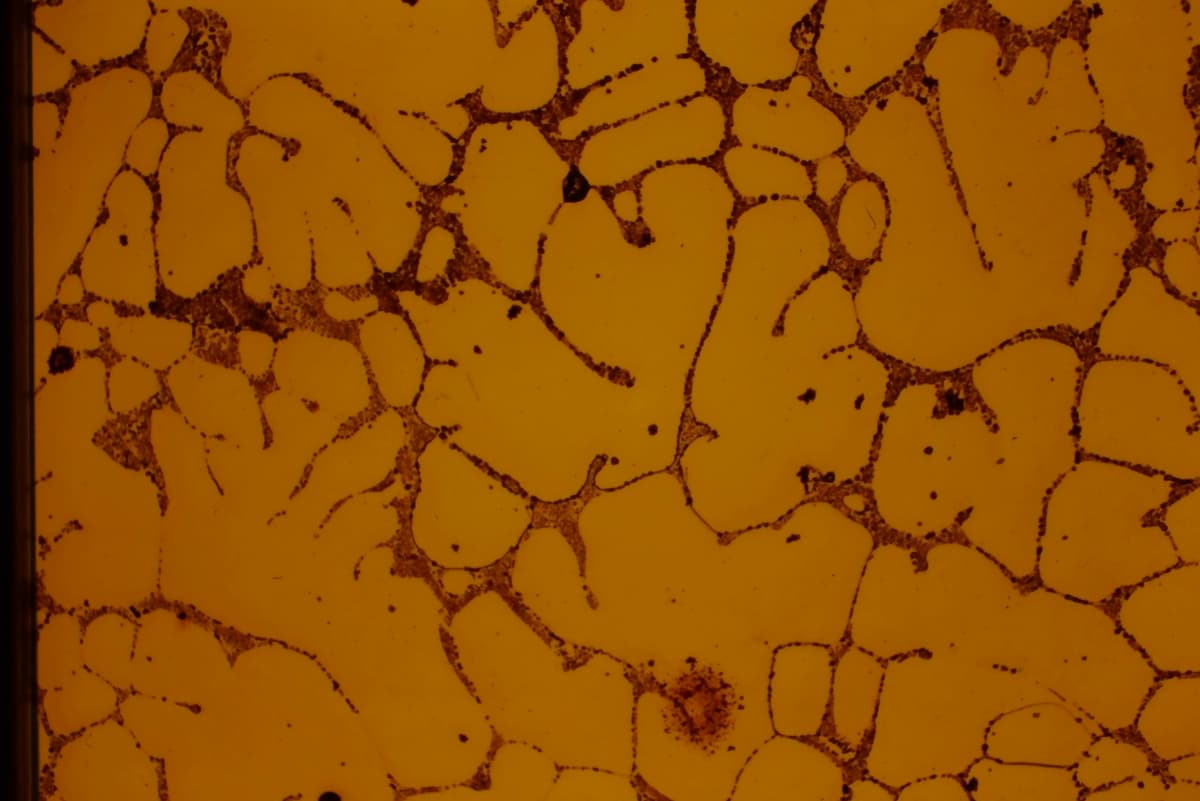
Tough pitch copper, ASTM No. 30 etchant, 200X magnification. This image demonstrates the proper microstructure revealed through correct preparation techniques.
Copper alloys can be challenging due to their softness and tendency to deform and smear easily. The key is to use appropriate abrasives, maintain light pressure throughout the process, and avoid over-polishing which can introduce relief and smearing. Different copper alloys may require slight variations in technique. For example, softer alloys like electrolytic tough pitch copperrequire extra care to prevent smearing, while harder alloys like beryllium coppercan tolerate slightly higher pressures during preparation.
Beryllium safety — required reading before preparing any BeCu (C17200, C17500, C17510) sample.Beryllium dust is a chronic respiratory hazard — inhalation causes Chronic Beryllium Disease (CBD), an irreversible lung condition that can develop years after exposure. Visible damage during the prep session is not the warning signal. Mandatory practice for BeCu:
- Wet cutting and grinding only — never dry-grind BeCu. Flood coolant during sectioning, water lubricant on every grit step.
- Respiratory protection appropriate for soluble Be dust if there is any chance of dry abrasive contact (N95 minimum, P100 for routine BeCu work).
- Sealed disposal of all grinding waste — used papers, polishing pad surfaces, swarf, rinse water. Treat as hazardous waste per institutional procedure.
- Decontaminate work surfaces after each sample (wet wipe, not dry brush).
After these controls are in place, BeCu preps as a standard hard copper alloy (NH₄OH + H₂O₂ etch, Klemm I for color). The hazard is the dust generation, not the chemistry.
Sectioning
When sectioning copper and copper alloy samples, run the abrasive cutoff wheel at typical metallographic surface speeds (roughly 2,500-4,500 SFM) and control heat with a light feed rate and copious coolant rather than by slowing the wheel — an under-speeded wheel glazes and rubs instead of cutting. Copper's softness requires careful handling to prevent deformation and smearing. This is especially important for pure copper grades like C11000and softer brass alloys like C26000 cartridge brass.
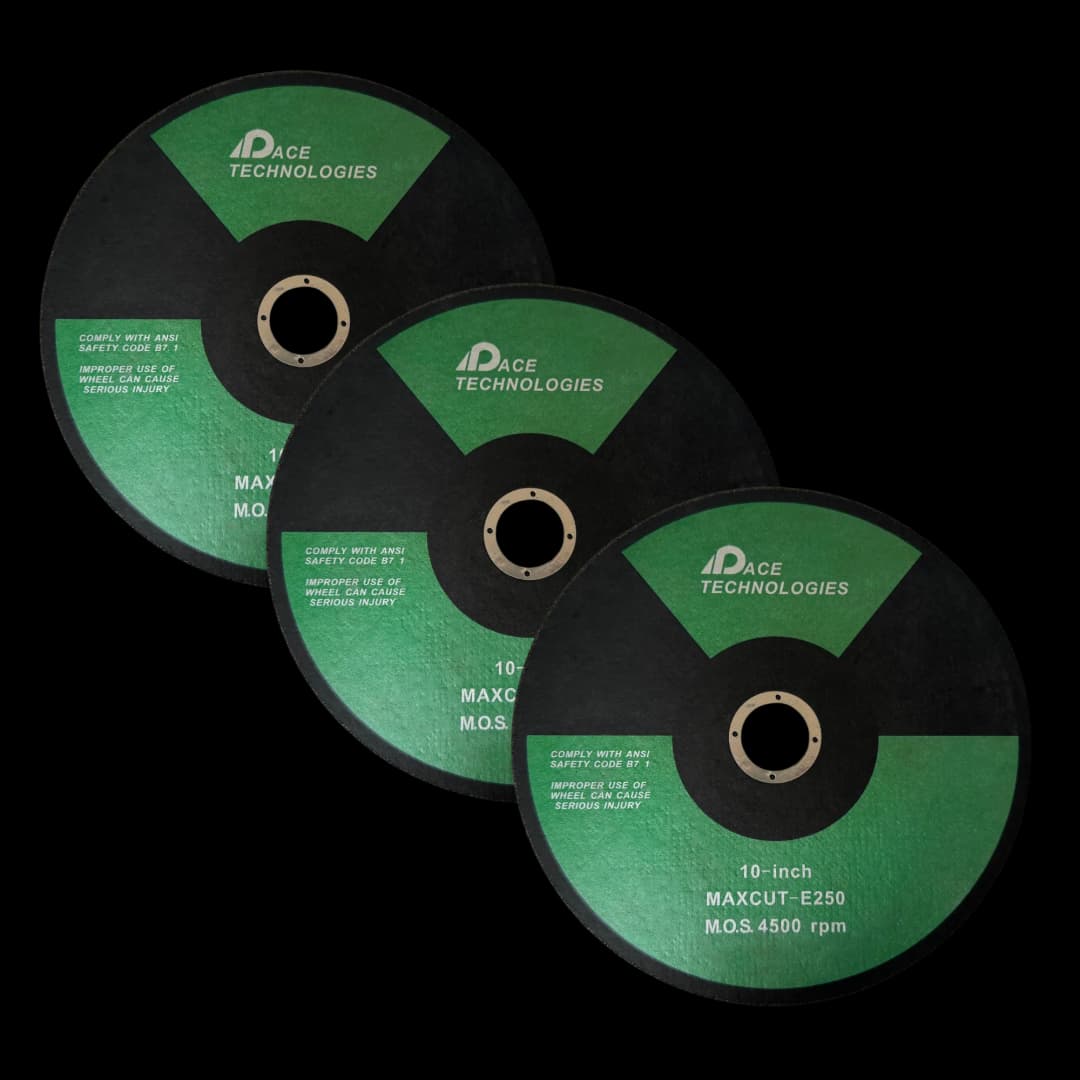
Soft-bond abrasive cut-off blades formulated for soft non-ferrous metals (aluminum, copper, brass). Thin blades (0.5-1.0 mm) minimize heat generation and deformation.
- Use a soft-bond abrasive blade formulated for soft non-ferrous metals (Al, Cu, brass). Do not substitute a hard non-ferrous (titanium-class) blade or any steel-class blade — the bond chemistry is wrong and the blade will glaze or load.
- Use a thin abrasive cut-off wheel (0.5-1.0 mm thickness)
- Apply steady, light pressure to avoid deformation
- Use adequate coolant to prevent overheating and smearing
- Allow the wheel to do the cutting - avoid forcing
- Consider using a slower feed rate than for harder materials
Example Products: Soft Non-Ferrous Abrasive BladesSoft-bond abrasive blades formulated for soft non-ferrous metals — aluminum, copper, and brass
For purchasing options and product specifications, see commercial supplier website.
Mounting
Mounting provides edge retention and easier handling. For copper and copper alloys, compression mounting with phenolic or epoxy resins works well. Cold mounting with epoxy is also suitable and avoids potential heat-related issues that could affect the microstructure.
Compression Mounting
- Clean the sample thoroughly to remove cutting fluid and debris
- Place sample in mounting press with appropriate resin
- Apply pressure: 3000-4000 psi for phenolic, 2000-3000 psi for epoxy
- Heat to 150-180°C and hold for 5-8 minutes
- Cool under pressure to room temperature
Cold Mounting
- Clean and dry the sample
- Place in mounting cup with epoxy resin
- Allow to cure at room temperature (typically 4-8 hours)
- Cold mounting avoids heat that could affect copper microstructure
Grinding
Grinding removes sectioning damage and prepares the surface for polishing. Start with coarse grits and progressively move to finer grits. For copper and copper alloys, use lighter pressure than for harder materials to avoid deformation. We recommend starting with 240-320 grit and progressing through finer grits. This approach works well for common alloys like C26000 cartridge brassand C36000 free-cutting brass:
Abrasive choice — alumina vs. SiC: Copper is soft enough that SiC particles can liberate from the paper and embed in the matrix, where they resist removal in subsequent steps. The standard recommendation for soft non-ferrous (Al, Cu, brass) is an alumina (Al₂O₃) abrasive paper — bonded more strongly into the backing than SiC, with less liberation and less embedment. SiC is acceptable as a fallback (especially on harder bronzes that don't smear as easily as pure Cu), but inspect for embedded dark specks after fine grinding. The sequence below uses SiC as the most widely stocked option:
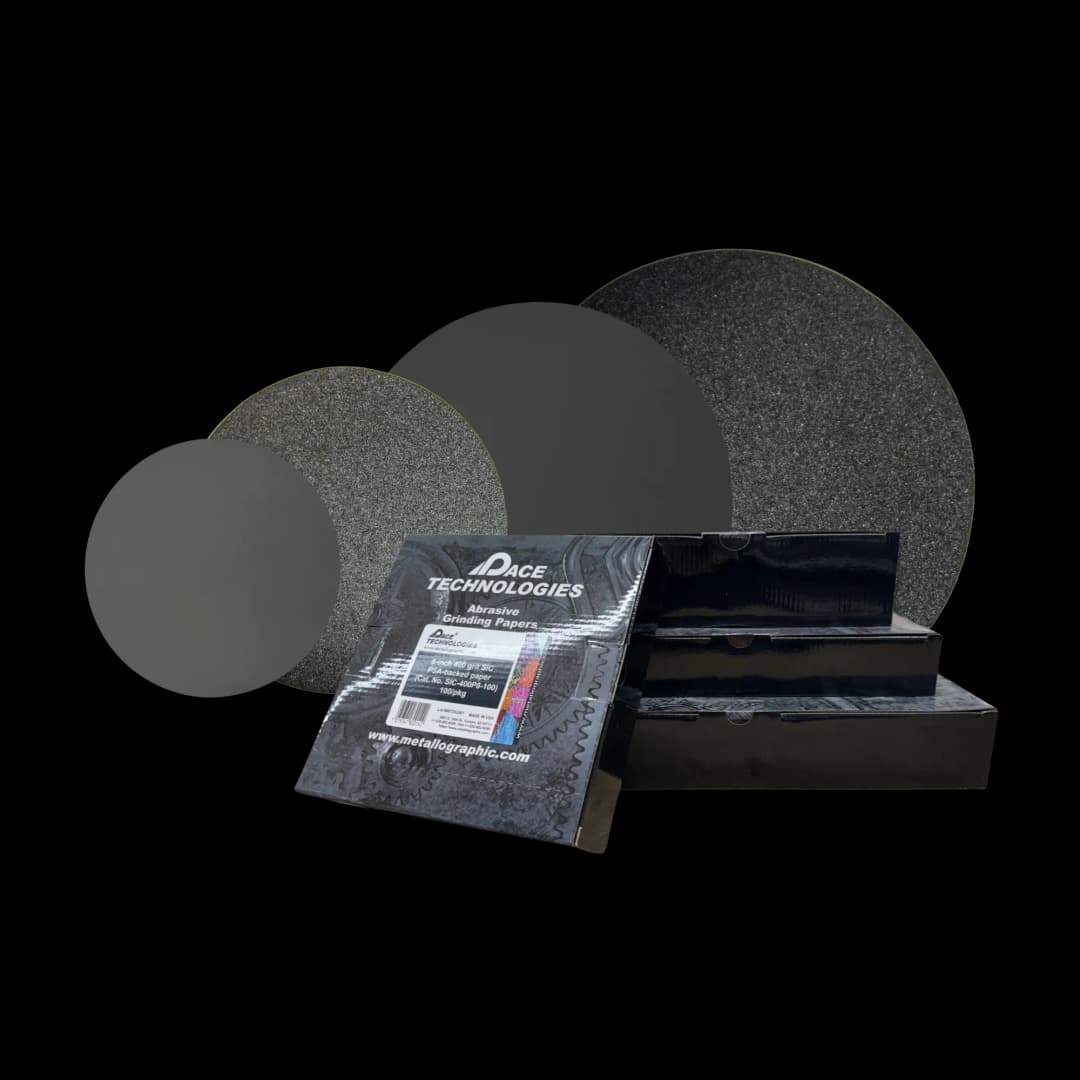
Silicon carbide (SiC) grinding papers in various grit sizes (240, 320, 400, 600) for progressive grinding. Rotate sample 90° between each grit to ensure complete scratch removal.
Grinding Sequence
- 240 grit: Remove sectioning damage and grind until plane (typically about 1 minute)
- 320 grit: Remove previous scratches (1-2 minutes)
- 400 grit: Further refinement (1-2 minutes)
- 600 grit: Final grinding step (1-2 minutes)
Important: Rotate the sample 90° between each grit to ensure complete removal of previous scratches. Use water as a lubricant and maintain light pressure to avoid deformation — heavy pressure on copper drives deep subsurface deformation that polishing cannot fully remove, and it returns as scratches after each etch. For very soft copper alloys, you may start with 240 grit instead of 120 grit to minimize deformation.
Example Products: Silicon Carbide Grinding Papersappropriate SiC papers in all grit sizes for consistent grinding
For purchasing options and product specifications, see commercial supplier website.
Polishing
Polishing removes grinding scratches and prepares a mirror-like surface. For copper and copper alloys, diamond polishing followed by oxide polishing typically yields excellent results. Use lighter pressure than for harder metals, and control smearing with the chemo-mechanical final step below rather than with ever-softer cloths — softer cloths trade smearing for relief. The recommended sequence is 9 μm → 3 μm → 1 μm diamond, followed by final polishing with 0.05 μm colloidal silica.
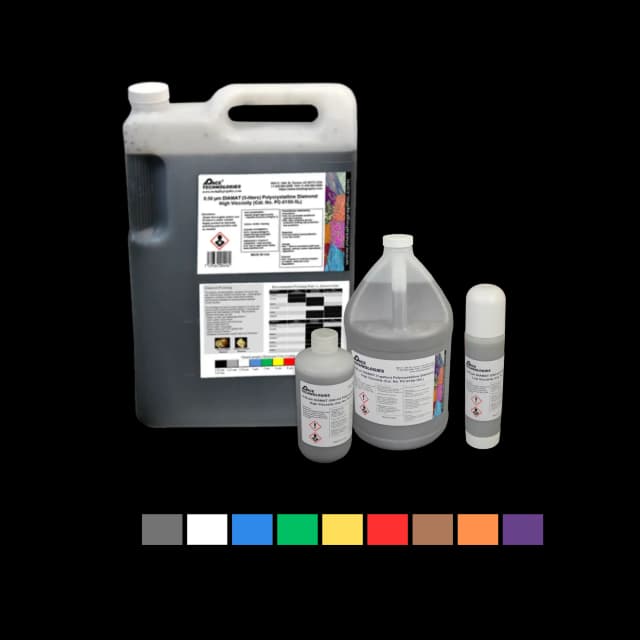
Polycrystalline diamond compound provides consistent cutting action for copper alloys.

Start diamond polishing on a hard woven cloth and reserve softer napped cloths for the final steps to limit smearing and relief.
Diamond Polishing
- 9 μm diamond: 4-5 minutes on a hard woven cloth — starting diamond on a soft napped cloth smears copper
- 3 μm diamond: 3-4 minutes on a medium napped cloth
- 1 μm diamond: 2-3 minutes on a soft napped cloth
Final Polishing — Chemo-Mechanical with H₂O₂
Plain colloidal silica is not enough on copper. Pure Cu maintains a stubborn deformation/smear layer from polishing that ordinary mechanical action won't lift — the surface looks mirror-bright but won't take NH₄OH+H₂O₂ etchant cleanly because mechanical homogenization has wiped out the orientation differences between grains. The canonical Cu final step is a chemo-mechanical attack-polish: colloidal silica modified with hydrogen peroxide.
- 0.04-0.05 μm colloidal silica + 5-10% H₂O₂ (3% strength): 3 minutes on a chemotextile pad at light pressure (~10 N), followed by a 30 s water flush on the same pad to clear silica residue. Mix the silica + H₂O₂ fresh; the peroxide loses activity within hours.
- Rinse with water, then ethanol, and air-dry. The surface should now etch within seconds rather than blotchy or not at all.
Important: Use lighter pressure than for steel. Over-polishing can introduce relief around second phases and inclusions. Monitor the surface frequently — if smearing returns, the H₂O₂ has decayed; mix fresh rather than polishing longer.
Etching
Etching reveals the microstructure by selectively attacking grain boundaries and phases. The canonical first-pass etch for Cu, brass, and bronze is NH₄OH + H₂O₂(also known as ASTM No. 30 in pre-mixed bottle form). For phase color contrast in brass, bronze, and aluminum bronze, layer Klemm I or Klemm II tint etches on top — these produce vivid blues/reds that distinguish α-eutectoid phases that grayscale Nital-style etches cannot.
Tough pitch copper etched with ASTM No. 30, 200X magnification. Proper etching reveals grain boundaries and phase structure without over-etching artifacts.
Common Etchants for Copper and Copper Alloys
- NH₄OH + H₂O₂ (also called ASTM No. 30 — the canonical Cu/brass etch): Equal volumes of 28% NH₄OH and 3% H₂O₂. Apply by swab for 10-60 s. Mix immediately before use — activity decays within minutes; if the etch starts working sluggishly, mix a fresh batch. The default first-pass etch for C11000 ETP, OFHC, C26000 cartridge brass, C36000 free-cutting brass, and most phosphor and aluminum bronzes. Reveals grain boundaries and twin boundaries.
- Klemm I (color tint — Cu and brass): 50 mL stock (saturated Na₂S₂O₃) + 1 g K₂S₂O₅. Immerse 30-180 s. Stock for Klemm I = 250 g Na₂S₂O₃ in 100 mL H₂O. Produces vivid blue/red color contrast that distinguishes grain orientations in pure Cu and brass — very useful for automated grain-size counts and orientation studies. Surface must be deformation-free for Klemm to develop properly (this is where the H₂O₂ chemo-mechanical final polish above pays off).
- Klemm II (color tint — brass, bronze): Same stock as Klemm I with a larger metabisulfite addition (50 mL stock + 5 g K₂S₂O₅). Immerse 30-180 s. Stronger than Klemm I; the best choice for α-brass and useful for general phase imaging in bronzes. For α-eutectoid color contrast in Cu-Al aluminum bronze (C61000, C63000), reach for Klemm I — it gives the vivid phase distinction that no grayscale etch can match.
- Copper No. 1 (more aggressive HNO₃ variant): 50% HNO₃ in H₂O (typically 125 mL HNO₃ + 125 mL H₂O). Faster and more aggressive than NH₄OH+H₂O₂ — useful when the standard etch under-attacks a heavily-deformed surface, but tends to over-etch and produce pitting. Not the default first-pass choice.
- Potassium Dichromate (K₂Cr₂O₇ + H₂SO₄): 2 g K₂Cr₂O₇, 8 mL H₂SO₄, 4 mL saturated NaCl, 100 mL H₂O. For specialty grain-boundary work in brass and bronze. Cr(VI) — disposal regulated as hazardous waste.
- Ammonium Persulfate (10 g (NH₄)₂S₂O₈ in 90-100 mL H₂O): Mild grain-area etch for pure copper, brass, and bronze. Gentler than HNO₃, but it must also be prepared fresh — the solution decomposes within a day or two.
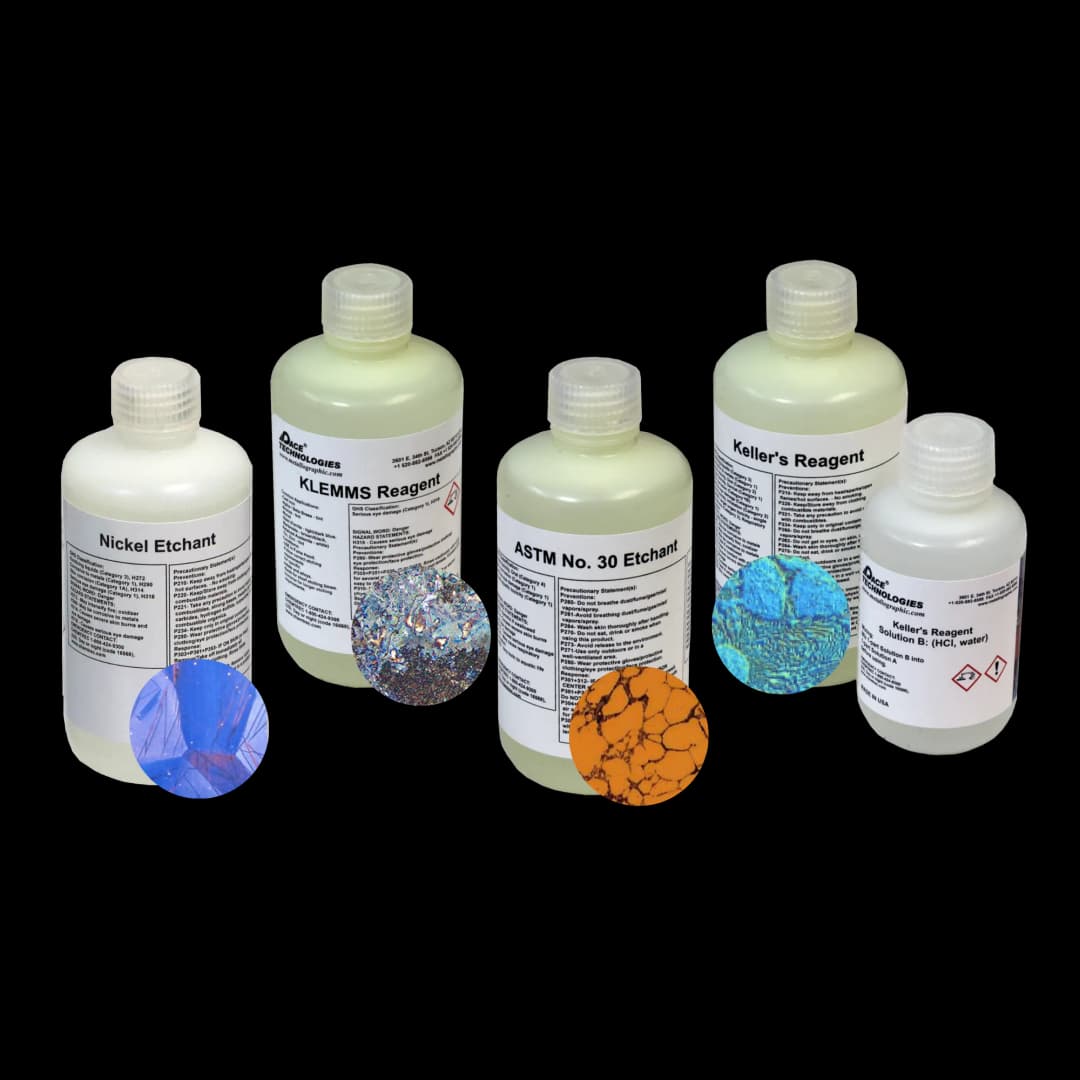
Etching solutions and reagents for copper and copper alloys. The canonical first-pass etch is NH₄OH + 3% H₂O₂ in equal volumes (also called ASTM No. 30); follow with a Klemm tint etch for color contrast — Klemm I for pure Cu, brass, and α-eutectoid work in aluminum bronze, or the stronger Klemm II for α-brass. Mix NH₄OH + H₂O₂ fresh — activity decays in minutes.
Etching Procedure
- Ensure sample is clean and dry
- Apply etchant with cotton swab or immerse sample
- Etch for 5-60 seconds (time varies by etchant and alloy — NH₄OH + H₂O₂ typically 10-60 s by swab; Copper No. 1 typically 5-45 s at 20°C)
- Immediately rinse with water, then alcohol
- Air-dry or use cool compressed air — avoid heated air, which can drive surface recrystallization on soft copper
Tip: Start with shorter etching times (5-10 seconds) and increase if needed. NH₄OH + H₂O₂ (ASTM No. 30) must be mixed fresh — activity decays within minutes, and a sluggish etch is a fresh-batch problem, not a longer-time problem. For phase color work, follow the NH₄OH+H₂O₂ general etch with a Klemm tint by immersion 30-180 s (Klemm I for pure Cu, brass, and aluminum bronze α-eutectoid contrast; Klemm II for α-brass) — the Klemm tint develops on top of the structural etch. Klemm requires a deformation-free surface; if the colors come out muddy or uneven, the H₂O₂ chemo-mechanical final polish was incomplete.
Example Products: EtchantsPre-mixed and custom etching solutions for copper and copper alloys, including ASTM No. 30 (NH₄OH + H₂O₂) and Klemm tint etches for brass and bronze color contrast
For purchasing options and product specifications, see commercial supplier website.
Troubleshooting
Common Issues and Solutions
- Scratches remaining: Insufficient grinding/polishing time or skipped grits. Ensure complete scratch removal at each step.
- Smearing (mirror finish that won't take an etch): The dominant Cu prep failure. Mechanical polishing has homogenized the surface — orientation differences between grains have been smeared flat, so chemical etchants find no boundaries to attack. The fix is the chemo-mechanical final polish with H₂O₂ (5-10% H₂O₂ in colloidal silica on a chemotextile pad, 3 min + flush) — the peroxide chemically removes the smear layer that plain silica leaves behind. Softer cloths alone do not fix smearing on Cu; they just produce a fresh smear layer at lower pressure. If smearing returns after the H₂O₂ step, the peroxide has decayed; mix a fresh batch.
- Relief around second phases: Over-polishing or too soft a cloth. Reduce polishing time or use slightly harder cloth.
- Contamination: Clean between steps, use fresh abrasives, and ensure proper sample cleaning. Copper can easily pick up contamination.
- Deformation: Too much pressure during grinding or polishing. Use lighter pressure throughout the process.
- Over-etching: Reduce etching time or dilute etchant. Start with shorter times (5-10 seconds).
- Pitting after etching: Etchant too strong or etching time too long. Dilute etchant or reduce time. Ensure fresh etchant solution.
- Poor grain boundary contrast: Try different etchant or increase etching time slightly. Ensure sample is properly polished before etching.
Explore More Procedures
Browse our comprehensive procedure guides for material-specific preparation methods and get personalized recommendations.